
What CMOs can teach us about innovation in uncertain times

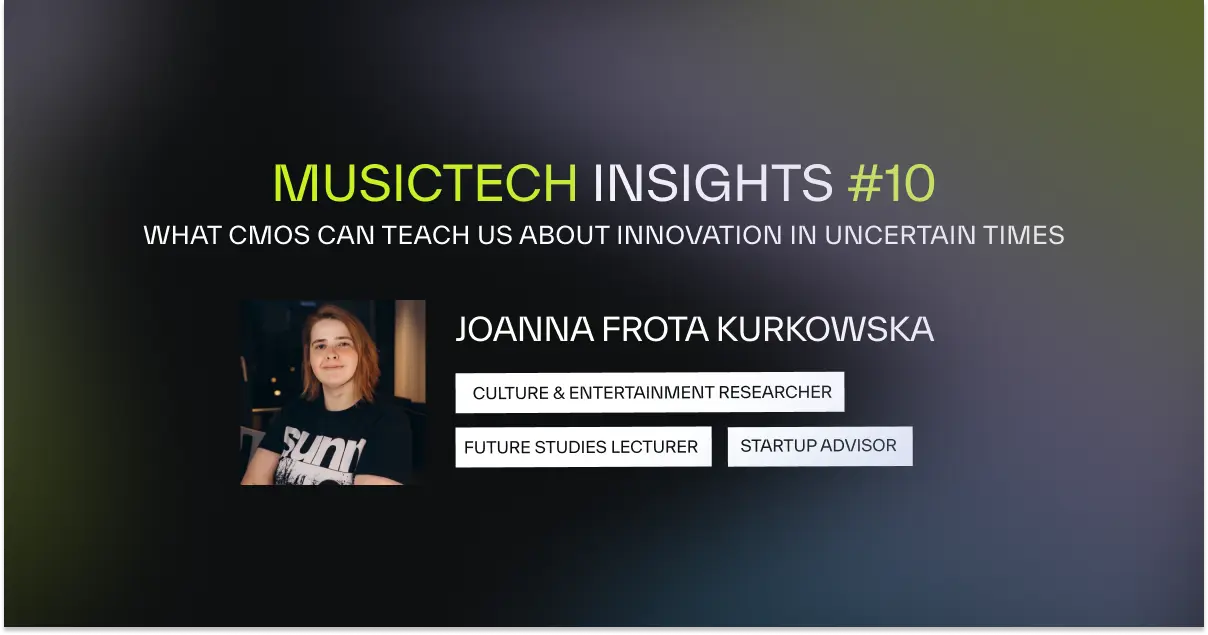
MusicTech Insights #10 | Curated by Joanna frota Kurkowska
This issue is guest-curated by Joanna Frota Kurkowska, Head of Strategic Research at ZAiKS Lab (part of Stowarzyszenie Autorów ZAiKS). With experience across entertainment, culture, gaming, and venture ecosystems, she brings a multidisciplinary perspective that connects traditional copyright management with emerging technologies.
In this edition, she shares her insights into how century-old institutions are innovating to meet modern challenges like AI training data and blockchain. As a researcher and expert in "Composable Culture," she breaks down the intersection of creative rights and tech innovation. We’re excited to share her perspective on the stories shaping the industry today. To get future issues of MusicTech Insights straight to your inbox, subscribe on our site.
What CMOs Can Teach Us About Innovation in Uncertain Times
Hi, I’m Joanna.
Have you ever wondered what happens when an organization that has been protecting creators’ rights since before the invention of the radio decides it needs to understand blockchain, AI training data, and API interoperability?
You get something fascinating and increasingly necessary. For those unfamiliar with CMOs, these are organizations that manage copyright on behalf of creators. They collect royalties when your song plays in a café in Warsaw or is streamed by a fan in Australia, ensuring you get paid when your composition appears in a German advertisement. In short, they are highly creator-focused, ensuring that people behind music, text, or image creation are fairly and consistently compensated.
To my surprise, I moved from the world of ecommerce, gaming, and entertainment into one of these organizations, ZAiKS Lab, almost 1.5 years ago, and I am still fascinated by it enough to write this piece.
Short history lesson
These organizations have been around for over a century. SACEM in France was founded in 1851. ZAiKS in Poland has been operating for over 100 years. GEMA in Germany and ASCAP in the US are all institutions built on legal precision, relationship management, and the slow, steady work of protecting creative output. And now they are all building innovation labs.
This might sound like a coincidence or a marketing gimmick, but the need comes from something very familiar to many established organizations in the 2020s. The systems that made them successful are being disrupted faster than they can adapt through traditional means. Technology evolves faster than ever, and distribution platforms are no longer a few channels like radio or TV, but thousands of digital services.
Consider what a CMO actually does. It processes massive amounts of data from digital service providers, including Spotify, Apple Music, TikTok, and YouTube, tracking which songs are played, where, and how often. It then matches this usage data against complex ownership graphs that define who wrote the song, who published it, and who owns which percentage of rights, and distributes royalties accordingly. This is essentially a data business disguised as a legal service or a fintech operation.
Now add generative AI to the mix. Suddenly, the question is not only who gets paid when a song is played, but also whether the model was trained on copyrighted material without authorization, and how creators can participate in AI-driven value creation instead of being displaced by it.
The traditional CMO playbook, which is based on licensing, collecting fees, and distributing royalties, does not yet fully address these questions. You cannot negotiate with an AI model trained on your repertoire without your knowledge. You cannot collect royalties from systems that generate music that sounds similar to your members’ work but is not technically a copy. This is one of the reasons CMOs are building labs, not to follow trends, but to adapt to long-term structural change.
Across the world, several CMOs have established formal innovation initiatives. Each has a slightly different flavor, similar to local cuisine or specialities, but they share a common DNA.
SACEM Lab 🇫🇷
SACEM Lab operates what I'd call a “structured open innovation” model. They explicitly frame their approach around three pillars: anticipating new technologies and trends, experimenting by testing high-value solutions with an agile approach, and sharing knowledge with their ecosystem. They offer external innovators a 1–3 month pilot program tied to real SACEM use cases. This isn’t theoretical. It’s applied innovation with a clear path to deployment.
SACEM has also been aggressive on the AI front. They’ve implemented an opt-out mechanism requiring prior authorization for AI training uses (effective since October 2023) and reportedly reached an agreement with Deezer to detect AI-generated music. They’ve also built Musicstart, a blockchain-based service for proof of authorship, targeting young creators who might not otherwise protect their works before distribution. One of their other products is URights, developed together with IBM.
One might say that partnering with a legacy IT company is not a source of innovation (the purists will say - only startups or AI counts!), but I think otherwise. Any kind of entry into the digital landscape, creating more technological products around problems that CMOs want to solve should count as innovation.
GEMA 🇩🇪
GEMA takes a different approach. Instead of branding a single “lab,” they have created an open innovation interface aimed at startups, research groups, and SMEs, supported by an innovation team and a technology radar. Their website explicitly invites collaboration and lists current partners working on areas ranging from artist analytics to curator matching.
What makes GEMA particularly interesting is their approach to AI. They have developed what they call an “AI licensing model”, designed to compensate creators both for training and downstream generation use. This goes beyond one-off buy-outs and aims to ensure ongoing participation of rights holders.
They have also pursued test-case litigation against generative AI providers, positioning themselves as the first collecting society to sue over unlicensed training use. This is innovation through legal strategy, not only product development.
ASCAP Lab 🇺🇸
ASCAP Lab leans more toward an accelerator and education model. Their annual "ASCAP Lab Challenge", run with NYC Media Lab and NYU Tandon, is a 12-week program providing mentorship and small grants to selected startups and university teams. The 2024 focus was on AI-enabled workflow, business process, and data exchange solutions, precisely the "plumbing" that causes friction in music markets.
ZAiKS Lab 🇵🇱
ZAiKS Lab is an initiative I have the privilege to represent. ZAiKS Lab was formally established in 2024 as an R&D initiative within Stowarzyszenie Autorów ZAiKS, Poland's largest collective management organization. But what makes it fascinating isn't just what it does, it's how it's structured and who runs it.
As Aga Samitowska, Head of ZAiKS Lab, describes it, the initiative "was created as a result of a natural need within the organization." Multiple modernization and technology analysis projects already existed inside ZAiKS, and they needed a coordinating center. This is important. ZAiKS Lab wasn't a top-down mandate or a marketing exercise. Again, it emerged from operational necessity.
The organization explicitly positions itself as a "conscious hybrid", functioning simultaneously as a think tank, accelerator, research lab, and dialogue space between the worlds of creativity, technology, and law. This multi-functionality is deliberate. As Aga Samitowska, Head of the lab, puts it, "ZAiKS Lab is not an attempt to catch up with something that has passed us by, on the contrary, we want to be an active participant and partner in this transformation." Unlike traditional CMO structures staffed primarily by legal and music industry veterans, ZAiKS Lab deliberately mixes experienced internal ZAiKS staff with new specialists from acceleration programs, R&D, and crucially people with backgrounds in startups, e-commerce, gaming, and entertainment technology. When one is trying to bridge the gap between a century-old legal institution and the iteration speed of MusicTech startups and the tech world, you need people who speak both languages. The "conscious hybrid" is not just an organizational structure, but the basis of a staffing philosophy.
As ZAiKS Lab is the entity I know the best, I can share hands-on experience, learnings, and especially projects. So let me get concrete about ZAiKS Lab's outputs, because this is where the rubber meets the road. Below are some projects that we're either currently developing or that are fresh out of the oven.
MusicTech Landscape
ZAiKS Lab has published a comprehensive map of the MusicTech landscape, a bit of a pet project of mine as I love lists, showcasing domains where music meets innovation, from therapy and health tech to data analytics and digital provenance. Alongside this, I've curated a growing database of over 400 global MusicTech startups, categorized by function and focus area. This should not be seen as a directory, but as ecosystem cartography designed to make MusicTech legible beyond "AI debates" and to surface investable niches and builder opportunities, or vibe coding opportunities. The database also serves other curious minds, helping people find tools that can support their work.
The Startups Copyright Guide
The Startups Copyright Guide prepared by Agnieszka Cichocka and Joanna Dębicka is a practical, jargon-light resource explaining ownership and usage risks around code, music, texts, and graphics. It's designed for teams building creative tech products who want to innovate responsibly without shipping legally fragile solutions. Available in Polish and English, it's free to access, a deliberate choice to lower barriers for early-stage innovators. This is a smart play, both as a knowledge distribution tool and a highly qualitative content marketing effort. One of the recurring friction points in creative tech is that startups often don't understand copyright until they've already built something that violates it. By providing education upfront, we believe we increase the probability that new MusicTech products integrate copyright correctly from the start and avoid mistakes with copyrighted content.
Collaboration with Warsaw University of Technology
ZAiKS Lab has established a strategic collaboration with Warsaw University of Technology, involving hackathons, competitions, training on copyright in AI and new media contexts, joint research, internships, thesis mentorship, and educational programming. There is a strong institutional belief that a partnership should be based on more than just a logo on a webpage, but on real activity and knowledge exchange between people from both sides. There is a hackathon in the works, scientific papers in progress, and active discussions around AI music, attribution, and watermarking. We believe that bridging the gap between a CMO and a scientific institution, and adding elements of business, creates an interdisciplinary mix that benefits all sides involved.
Innovators' Recognition
All of this has attracted interest from Polish technology builders and commentators. The Lab was selected for MamStartup's KREATORZY 2025/2026 ranking in the "Organizations and innovations" category. The recognition explicitly credited ZAiKS's digital transformation leadership and the creation of ZAiKS.LAB as an innovation center for the creative sector. This caused quite a stir in the environment, as most people associate ZAiKS with something old and siloed. Yet here we are.
This matters because legitimacy for innovation coming from established organizations is a prerequisite for convincing startups, universities, and investors to treat a CMO as a serious innovation partner. When a century-old institution is recognized alongside tech-native organizations for innovation, it signals that the transformation is real. This approach can also work for other established organizations, even outside music and sound, by bringing in people from new paradigm industries, integrating them into legacy structures, and running diverse types of projects.
The Polish lab is, I think, a very effective example. But here I want to zoom out, because the lessons from CMO innovation labs extend far beyond music rights management.
- Established institutions can innovate, but they need new structures to do it. The "lab" model allows organizations to experiment at iteration speeds that would be impossible within their core operations. It creates a protected space where failure is acceptable and where people with non-traditional backgrounds can contribute without being filtered out by institutional antibodies.
- Ecosystem thinking beats product thinking. At ZAiKS Lab we started not with product building, as one might expect, but with building an ecosystem. The Music Tech Map, the startup database, academic partnerships, and event presence are all investments in becoming a convening node between creators, researchers, and technologists. This is harder to measure than product metrics, since some of these activities have indirect impact, but it is arguably more valuable for long-term positioning.
- The "conscious hybrid" model is transferable. Any established organization facing technological disruption could learn from ZAiKS Lab's staffing approach: deliberately mixing institutional veterans with people from adjacent, faster-moving industries. The friction this creates is productive, as it forces translation between worldviews and prevents the lab from becoming either too detached from the parent organization or too constrained by its existing assumptions.
- Legal and ethical positioning is a form of innovation. GEMA's AI licensing model, SACEM's opt-out mechanism, and KODA's litigation strategy are market-shaping innovations that define the rules of engagement for an entire industry. For organizations with regulatory or ethical mandates, innovation through policy can be as impactful as innovation through product.
The future of entertainment, creative industries, and rights management is being shaped right now, in labs, in pilot programs, and in partnerships between institutions that have never worked together before. CMOs like ZAiKS, SACEM, and GEMA are demonstrating that century-old organizations can adapt to technological change without abandoning their core missions. They are building bridges between legal precision and startup iteration speed, and between creator protection and technological possibility.
For other established organizations watching from the sidelines, whether in media, publishing, education, or beyond, the message is clear. The choice is not between innovation and institutional integrity. The choice is between participating in the transformation or being transformed by it. ZAiKS Lab, with its conscious hybrid model, its ecosystem-building approach, and its deliberate staffing of people who understand both worlds, offers a template worth studying. Not because it has all the answers, but because it is asking the right questions and showing up to find them. The future of digital exploration is bright, and the organizations that thrive will be those that build the capacity to explore it.
Let's Build Something Together
Have a similar project in mind? We'd love to hear about it.
Get in touch to discuss how we can help bring your vision to life.
MusicTech Insights #1 by Maciej Dulski
Handpicked articles, updates, and insights from the fast-moving world of music and entertainment technology, curated just for you.
Feeling the MusicTech Momentum
Handpicked articles, updates, and insights from the fast-moving world of music and entertainment technology, curated just for you.
Related Articles
Newsletter
Get music tech insights, case studies, and industry news delivered to your inbox.