
The New Economics of Game Music

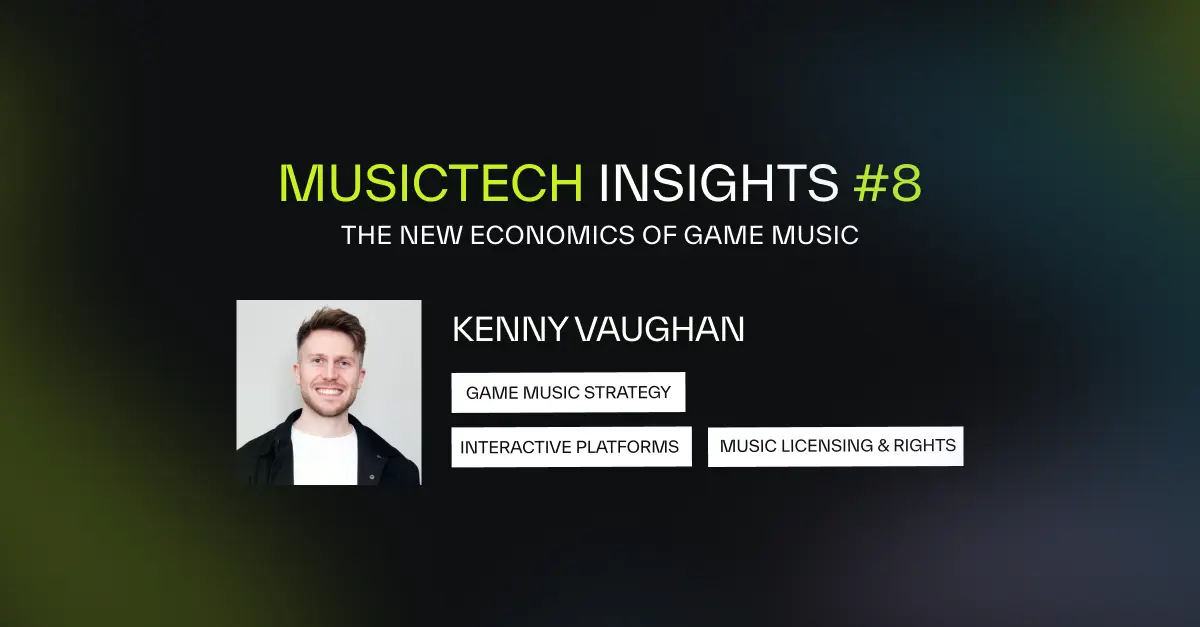
MusicTech Insights #8 | Curated by Kenny Vaughan
This issue is guest‑curated by Kenny Vaughan, who works at the intersection of music, technology, and gaming. With over a decade of experience across music licensing, supervision, partnerships, and product strategy, Kenny brings a unique perspective on how creative ambition meets real‑world systems and processes.
In this edition, Kenny dives into the evolving role of music in gaming and interactive experiences, sharing sharp, contrarian insights on what drives cultural impact, how creative intent translates into scalable systems, and where the next opportunities in MusicTech lie. We’re excited to share his perspective and his pick of the most relevant stories shaping the industry today, and to get future issues of MusicTech Insights straight to your inbox, subscribe on our site.
The New Economics of Game Music
Hi, I’m Kenny Vaughan.
I’ve spent my career tracking how music moves through culture as the systems around it change. From record shops and physical retail, through piracy and early digital platforms, into streaming at scale and social media recontextualisation, each shift has fragmented exposure while flattening intent. Alongside that, music in games has quietly existed as a cultural vessel for those who knew where to look, carrying identity outside of traditional marketing pathways.
What interests me now is how gamified and interactive platforms are bringing that idea to the surface. Games allow music to exist in new contexts rather than exclusively direct-to-fan feeds. I believe this shift will continue to reframe traditional marketing routes by creating smaller, more deliberate moments where music feels discovered rather than delivered._
You can read my wider thoughts on my blog Between Music & Gaming, or work with me via Feel For Music.
What happens when players bring their own music into games
Music gains much of its power in games through context. The value comes from curation, where a deliberate selection of tracks becomes part of a game’s identity and is remembered alongside play. That association is what makes music in games feel meaningful rather than interchangeable.
Spotify integration introduces an interesting tension - giving players access to their entire catalogue offers freedom, but risks stripping away context and, with it, a sense of musical identity. If every game can sound like everything, the game itself risks sounding like nothing. The real question is how developers treat this integration, as a surface level feature, or as a curated system that still preserves intention and authorship.
Why curated music will define quality on Roblox.
Roblox’s current music offering feels limited, not due to a lack of artists, but because meaningful music integration at scale depends on tracking and monetisation, something the platform has only partially addressed through its DistroKid partnership. Prioritising access over payment may lower friction in the short term, but it also sets an uneasy precedent for how music is valued inside interactive platforms.
That said, this feels more like a starting point than an endpoint. Music has already shifted into the background of daily life while still shaping how experiences feel, and Roblox presents a clear opportunity to do better. If music were treated as a tracked, intentional part of the system, it would raise the quality of games while allowing artists and developers to benefit together. Improving the overall sensory experience through sound is a path toward more refined, premium experiences, not away from them. I believe this will eventually be the clearest indicator of quality of first impression beyond commitment to gameplay for Roblox games, making sound one of the clearest early indicators of perceived quality, before gameplay has time to prove itself.
Music catalogues becoming private equity funds.
Music catalogues are increasingly being treated like private equity assets. What began with Hipgnosis has expanded into a broader shift, with major labels focusing less on distribution and more on acquiring and holding rights at scale. The old bottlenecks of physical retail and early digital platforms have disappeared, leaving a market flooded with new releases and discovery driven by recontextualisation across social media, film, and games rather than artist development alone.
As a result, ownership has become the priority. Era-defining catalogues such as the 60s, 70s and 80s offer long term, predictable value, while contemporary music is harder to anchor beyond the moments that surface it. Labels are positioning themselves to benefit from value created elsewhere, reinforcing a model where control of rights matters more than how or where the music is actually used.
AI-driven selection and its impact on game music
The rise of agentic AI commerce introduces a new decision-maker into the creative economy, and it shifts decision-making further away from individual intent and toward systems-level optimisation. Google’s Universal Commerce Protocol actively solves your retail communication for you, being able to select and transact on behalf of users.
For music and games, this reframes how music assets are found and valued for commercial utility. When selection is driven by AI Agents, it makes sense they will categorise their selection by eligibility, rights clarity, price and contextual fit - highlighting a risk that they will repeatedly favour what is easiest to understand.
The very nature of the music industry relied on A&R’s going to grass roots venues and having an inspired belief that the artist they are watching can contribute to a wider musical culture if nurtured. Game developers that are not privy to the music supervision language will end up searching by broader, less specific terms regardless - potentially having the same tapering issue. This looming technical solution only proves a greater value for music supervision, ensuring that there will be a clearer difference between common tracks and themes versus curated and selected ones using professional music supervision, heightening the fan experience and perceived value of a game in comparison to the masses.
How fans reshape music beyond the game through Fan Refraction.
Fan engagement of game music is becoming less linear as the years go by. Rather than moving from discovery to fandom in a straight line, audiences now refract across platforms, contexts, and identities, interacting with music in fragmented but personal, meaningful ways. A track might first be encountered in a game, and resurface on social media in an entirely different way. But it’s also the case that a clip from a game may be shared with entirely new music through the lens of the fan.
A game needs to have a strong aesthetic (of its artwork as well as its musical identity), so it’s clear what juxtaposes it. This gives purpose to the fans of reimaginging the world in their own way as well as the game still having a striking and defining presence in its own right.
I call this Fan Refraction.This uses music both curated by the game, as well as fan-made selections, as tools to showcase fandom and in turn use music like a ‘hashtag’. The opportunity lies in designing systems that allow music to reappear at different moments, carrying emotional residue forward. Fan refraction rewards music that travels well across environments, while exposing the limits of strategies that rely on controlling attention in a single place.
Let's Build Something Together
Have a similar project in mind? We'd love to hear about it.
Get in touch to discuss how we can help bring your vision to life.
Low-Code Magic Won't Solve MusicTech Reality
Handpicked articles, updates, and insights from the fast-moving world of music and entertainment technology, curated just for you.
Music Business Meets Direct-to-Fan
Handpicked articles, updates, and insights from the fast-moving world of music and entertainment technology, curated just for you.
Related Articles

Newsletter
Get music tech insights, case studies, and industry news delivered to your inbox.