
Verified Human Cert MCP Server: Prove Your Music Is Human-Made, Right from the Terminal


Key Takeaways
The line between human-made and machine-generated music is getting blurry. Verified Human Cert (VHC) is one answer to that problem: a public registry where artists and labels certify that their tracks were created by humans.
We wanted to query that registry without leaving our terminal. So we built an MCP server for it and open-sourced it: mcp-verifiedhumancert.
What the server does
The server exposes six tools that map directly to the VHC public API:
| Tool | What it does |
|---|---|
vhc_verify_isrc | Verify a certification by ISRC code |
vhc_verify_track | Check certification status by artist + track name |
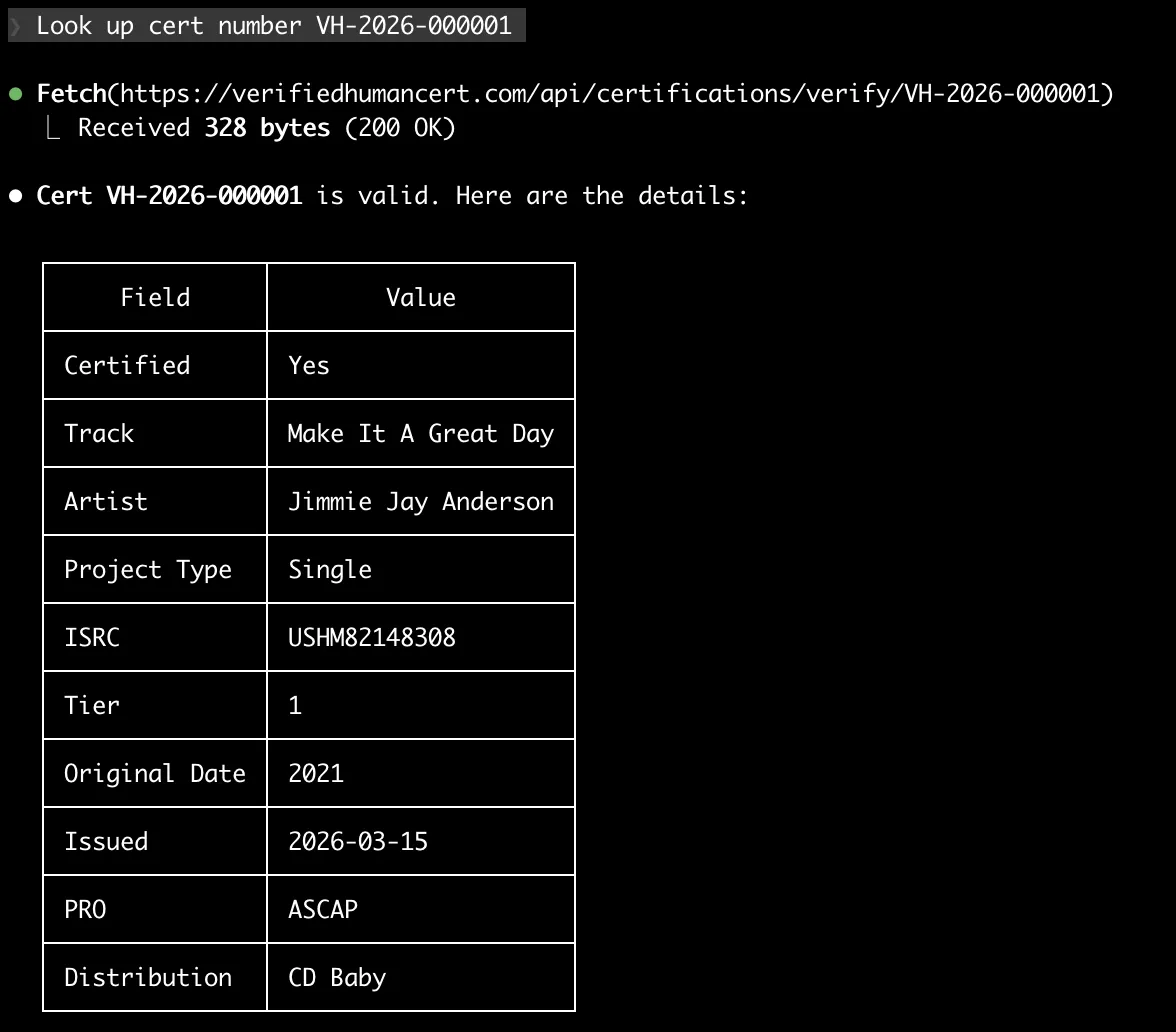
vhc_verify_cert | Look up a certification by cert number |
vhc_registry | List recently issued certifications |
vhc_stats | Platform statistics, tier breakdowns, totals |
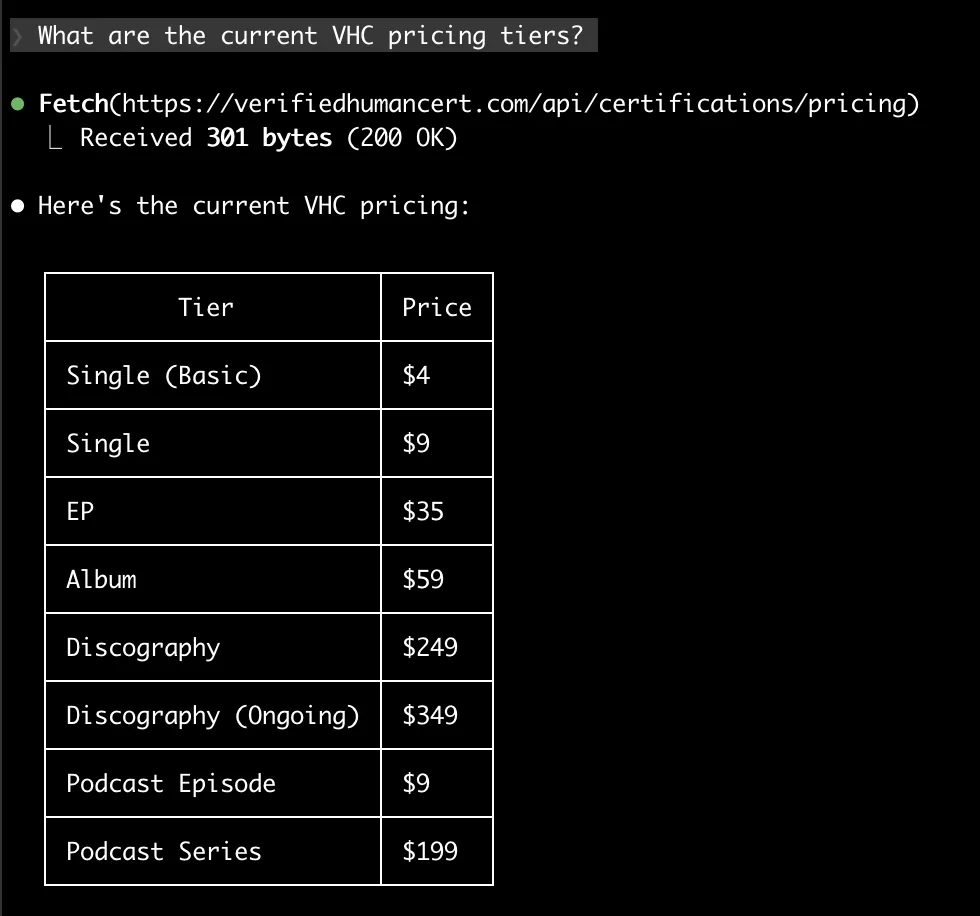
vhc_pricing | Current pricing and bundle options |
No API key needed. The VHC registry is public, and all these endpoints are read-only.
Once connected, you just talk to Claude:
- "Is ISRC USHM82148308 certified as human-made?"
- "Check if 'Yesterday' by The Beatles has a VHC certification"
- "Show me the latest certified tracks"
The multi-agent workflow
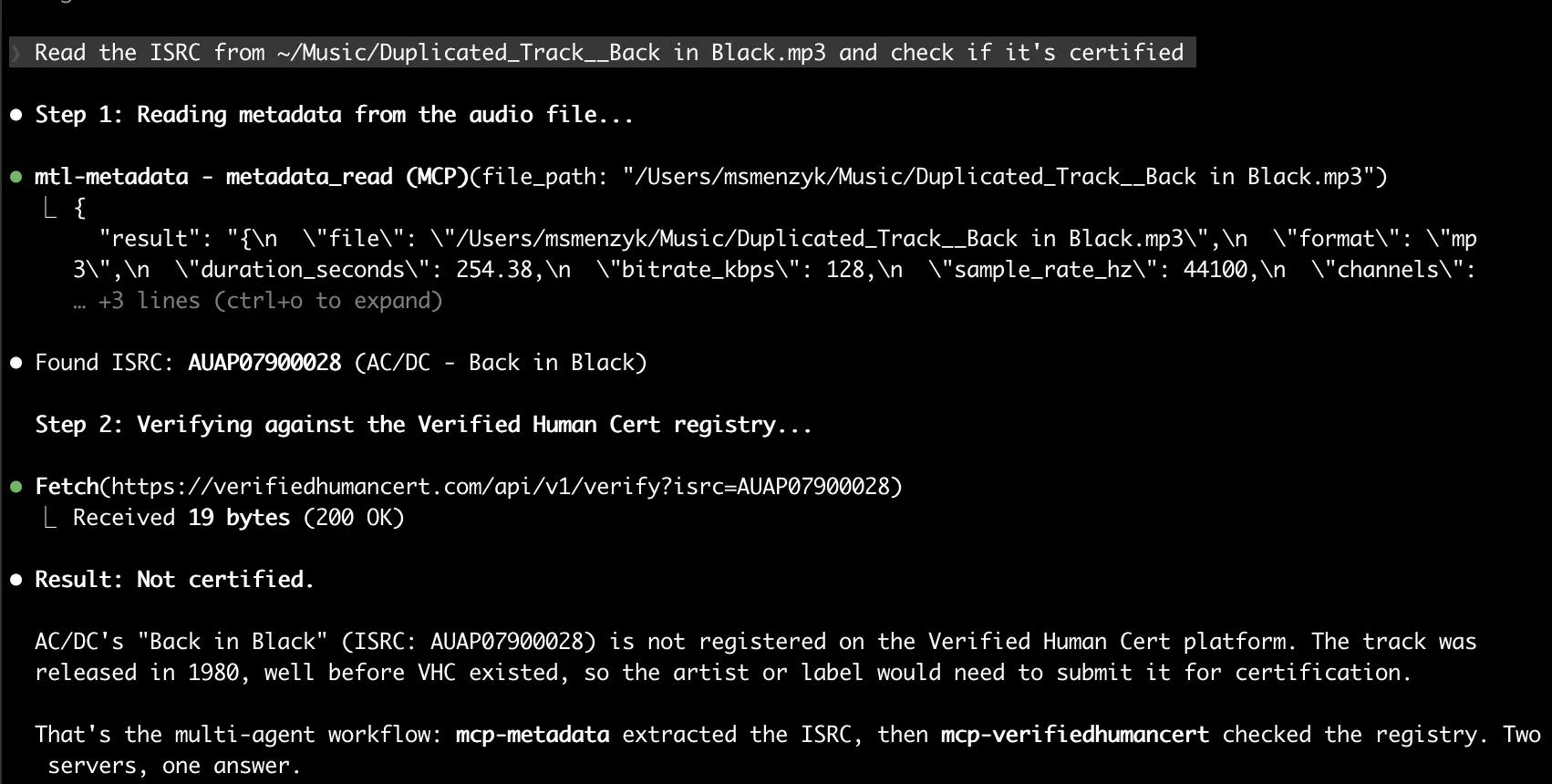
This is where it gets interesting. We already had mcp-metadata, our open-source MCP server for reading and writing audio file metadata (ID3 tags, ISRC codes, Vorbis comments). Combining the two servers creates a multi-agent pipeline:
- Agent 1 (mcp-metadata) reads the ISRC code from an audio file
- Agent 2 (mcp-verifiedhumancert) verifies that ISRC against the VHC registry
- Claude orchestrates both agents and presents the result
User: "Read the ISRC from song.flac and check if it's certified"

Agent 1 (mcp-metadata): metadata_read("song.flac") -> ISRC: USHM82148308
Agent 2 (mcp-verifiedhumancert): vhc_verify_isrc("USHM82148308") -> certified: true
Two MCP servers, two specialized agents, one orchestrator. No glue code, no custom integrations. Claude handles the coordination.
Why this matters for the music industry
The rise of generative audio tools has created a trust problem. Listeners, labels, and platforms need a way to distinguish human-created work from machine-generated output. VHC provides that layer of trust, and our MCP server makes it accessible to developers and tooling without building custom API integrations.
Setting it up
1. Clone and install
git clone https://github.com/musictechlab/mcp-verifiedhumancert.git
cd mcp-verifiedhumancert
poetry install
2. Register with Claude Code
Add this to your ~/.claude/settings.json or project .claude/settings.local.json:
{
  "mcpServers": {
    "vhc": {
      "command": "poetry",
      "args": ["--directory", "/path/to/mcp-verifiedhumancert", "run", "python", "-m", "mcp_verifiedhumancert"]
    }
  }
}
3. Start using it
That's it. Ask Claude anything about the VHC registry:
- "Look up cert number VH-2026-000001"
- "What are the current VHC pricing tiers?"
- "How many tracks are certified on the platform?"
Under the hood
The server is built with FastMCP, the Python SDK for the Model Context Protocol. The architecture is straightforward:
client.py- a thin HTTP wrapper around the VHC REST API using httpxserver.py- six tool definitions that call the client and return JSON- Tests - full test coverage using respx for HTTP mocking
@mcp.tool()
def vhc_verify_isrc(isrc: str) -> str:
    """Verify a human-made music certification by ISRC code."""
    result = client.verify_by_isrc(isrc)
    return json.dumps(result, indent=2, ensure_ascii=False)
def verify_by_isrc(isrc: str) -> dict:
    """Verify a certification by ISRC code."""
    return _get("/api/v1/verify", params={"isrc": isrc})
The entire server is under 200 lines of Python. That's intentional. MCP servers should be thin wrappers, not application frameworks.
What we learned building MCP servers
This is the third MCP server we have open-sourced at MusicTech Lab (after signnow-mcp and mcp-metadata). A few patterns have emerged:
- Keep servers focused. One server per domain. Don't bundle unrelated tools into a single server.
- Separate the client from the server. The HTTP client should be testable independently of the MCP layer.
- Return JSON, not prose. Let Claude format the output for the user. The server's job is to provide structured data.
- Skip authentication when you can. Public APIs make MCP servers trivial to set up. No
.envfiles, no OAuth flows, no token management.
Open source
The full source code is on GitHub: musictechlab/mcp-verifiedhumancert. MIT licensed. Contributions welcome.
If you're building MCP servers for the music industry, or if you're using Verified Human Cert and want to integrate it into your tooling, we'd love to hear from you.
Related resources
- GitHub: musictechlab/mcp-verifiedhumancert - the source code
- GitHub: musictechlab/mcp-metadata - audio metadata MCP server
- SignNow MCP Server: E-Signatures from Claude Code - our previous MCP server article
- Verified Human Cert - the certification platform
- Model Context Protocol - the MCP standard
Need Help with This?
Building something similar or facing technical challenges? We've been there.
Let's talk — no sales pitch, just honest engineering advice.
Codemagic MCP Server: Trigger Mobile CI Builds from Claude Code
We open-sourced mcp-codemagic, an MCP server that brings Codemagic CI/CD into Claude Code. List apps, trigger builds, check status, and cancel runs without leaving your terminal.
Migrating from TravisCI to Github Actions
A practical comparison of GitHub Actions vs TravisCI with a step-by-step migration guide. Learn why we switched and how to move your CI/CD pipeline smoothly.
Related Articles




Technical Partner
Technical partner at MusicTech Lab with 15+ years in software development. Builder, problem solver, blues guitarist, long-distance swimmer, and cyclist.
Newsletter
Get music tech insights, case studies, and industry news delivered to your inbox.