
Provenance, Not Detection, Is the Durable Answer

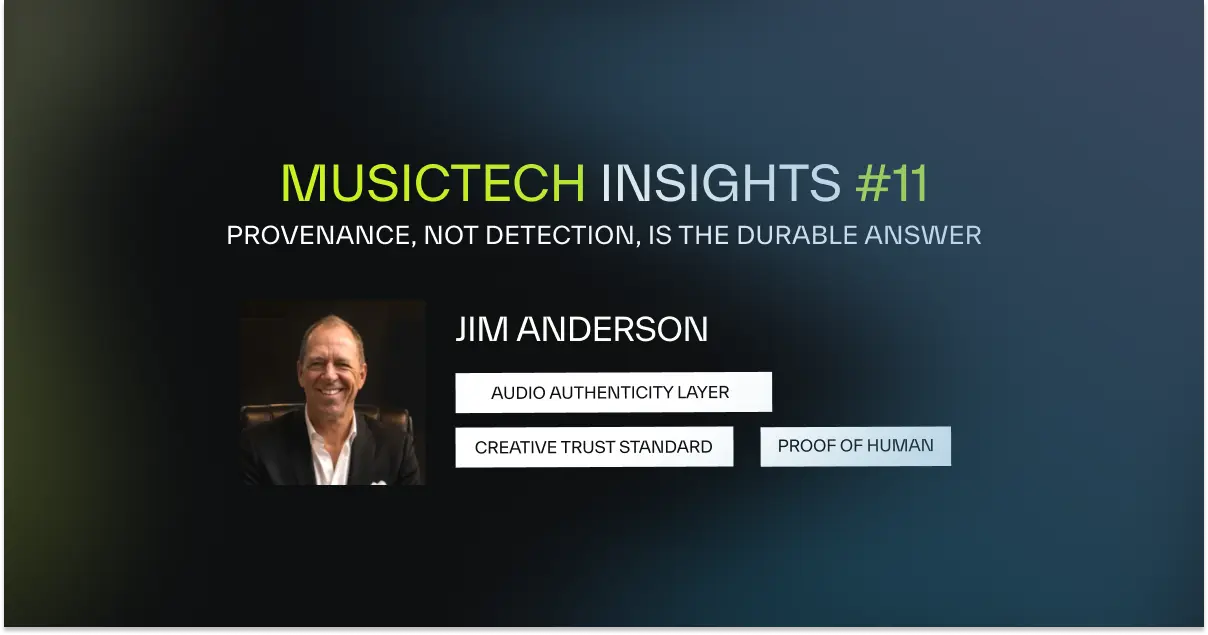
MusicTech Insights #11 | Curated by Jim Anderson
This issue is guest-curated by Jim Anderson, Founder of Verified Human. With over 35 years of experience as a music producer and live performer, and more than two decades in business leadership, he brings a rare combination of creative depth and operational expertise to today’s audio industry.
Through Verified Human, Jim is building an independent certification standard for human-made music and podcast audio, focused on verifying human authorship through a structured certification system used across platforms, advertisers, and rights holders. In this edition, he shares his perspective on how the industry is responding to rapid changes driven by AI, and why questions of verification and provenance are becoming increasingly central.
Provenance, Not Detection, Is the Durable Answer
Hi, I’m Jim.
For the past three decades I’ve worked as a music producer and live performer, and over the last 20 years I’ve also been building companies at the intersection of music, audio, and technology. Today I’m focused on one problem that is reshaping the entire industry: how we establish trust in a world where AI-generated audio is becoming indistinguishable from human-made work.
For the last three years, the industry’s main response to AI-generated music has been better detection. More classifiers. More models trained to identify synthetic audio. But detection is inherently fragile. Each new generation of AI makes it harder to keep up, and the gap between creation and detection keeps widening. In this edition I look at why the shift toward provenance, meaning verified chains of custody rather than post-hoc detection, is becoming the only scalable answer, and what early signals from platforms, regulators, and the market tell us about where this is heading.
How AI-Generated Music Became a $4 Billion Fraud Machine
Virginie Berger, former CEO of Armonia (the joint licensing venture of SACEM, GEMA, and PRS), reframes AI music as a fraud problem, not a moderation problem. She traces a direct line from the payola era to the Michael Smith case, where one operator allegedly extracted $80M in royalties via AI tracks and bot streams. Detection cannot win this race. Provenance can.
Apple Music Launches AI Transparency Tags, But Only If Labels Opt In
Apple has joined Spotify on listener-side AI disclosure. The catch reported by Music Business Worldwide (MBW) is the part to highlight. Tags only appear if labels and distributors voluntarily declare AI involvement. Self-attestation is a starting line, not a finish line. The next move from any major DSP will be to ask for a third-party signal, not a checkbox in a distributor portal.
Learn more (Music Business Worldwide)
Sorry AI Artists, Spotify Is Not Letting You Become Verified on Its Platform
Spotify just drew the line: AI-only artists cannot get a Verified badge. This is the first major DSP to use the word "verified" as a wedge between human and synthetic acts. The badge is a soft signal today. The infrastructure underneath it is the real story. Once verification has commercial weight, the standard that defines it wins the category.
Learn more (Music Business Worldwide)
EU AI Act Article 50: Provenance Becomes Law
Article 50 has been in force since August 2024, with full enforcement timelines through 2026. AI-generated and AI-manipulated content must be clearly labeled and machine-readable. Music is explicitly in scope. European PROs (SACEM, GEMA, PRS) are coordinating now. Every distributor selling into the EU will need a verifiable provenance signal.
Verified Human Public Verification API (Platform Page)
Live developer documentation for the open verification API that backs the USPTO Certification Mark for human-made music and audio (Serial #99666944). Any DSP, label, or podcast platform can query a track or episode by ISRC, podcast GUID, or certification number and get back a structured JSON response with tier, professionals credited, and issued date.
The Worst Thing You Can Do With a Certification Standard Is Grade Your Own Homework
The thinking behind why Verified Human invited MusicTech Lab to do a full independent technical and security audit before going to any major label or DSP. A USPTO certification mark is only as credible as the rigor behind it. You invite the scrutiny. You publish the findings. You let the market decide.
If you want more MusicTech Insights from the hidden corners of the music world, straight from the people actually running the show, our blog is the place to be. Leaders from all over the globe share what they’re seeing, thinking, and building, so you get the inside track without needing a private jet or a backstage pass.
Let's Build Something Together
Have a similar project in mind? We'd love to hear about it.
Get in touch to discuss how we can help bring your vision to life.
MusicTech Insights #1 by Maciej Dulski
Handpicked articles, updates, and insights from the fast-moving world of music and entertainment technology, curated just for you.
What CMOs can teach us about innovation in uncertain times
Handpicked articles, updates, and insights from the fast-moving world of music and entertainment technology, curated just for you.
Related Articles
Newsletter
Get music tech insights, case studies, and industry news delivered to your inbox.